
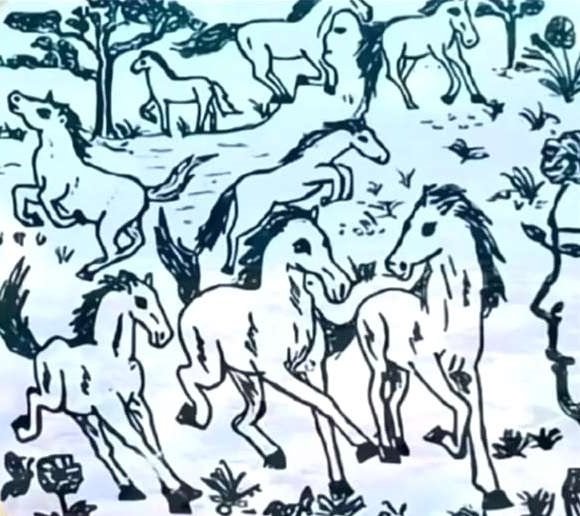
Have you ever found yourself staring at clouds… or the patterns in wood… and suddenly a face appears out of nowhere?
That’s called pareidolia—your brain’s incredible ability to recognize familiar patterns, especially human faces, in random shapes.
At first glance, this artwork looks li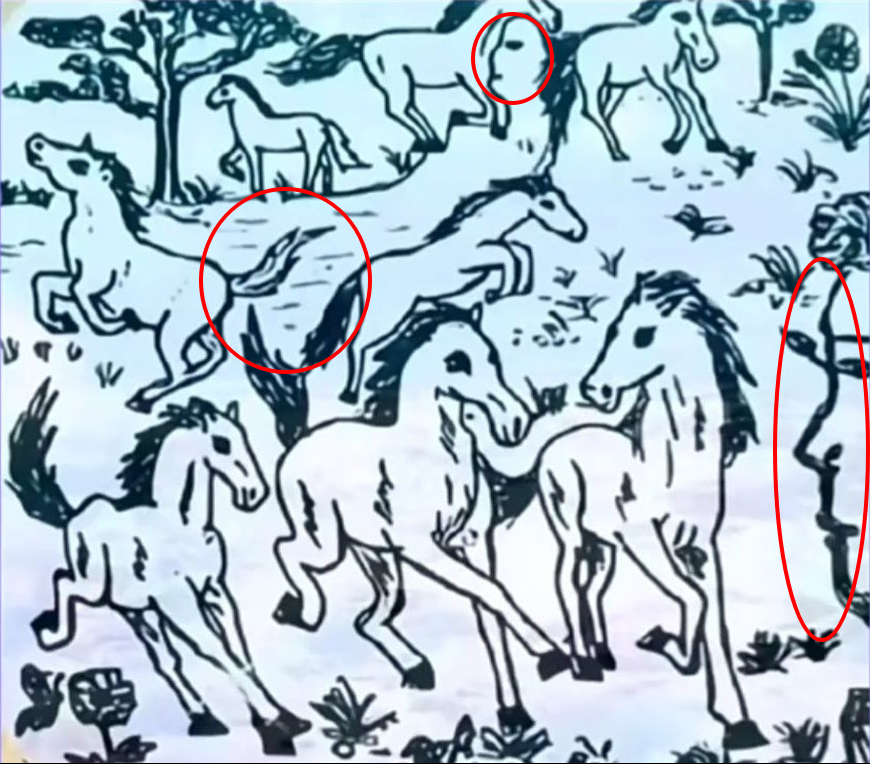 ke a powerful scene of galloping horses—wild, free, and full of motion. But look closer… much closer. Hidden within the curves of their bodies, their flowing manes, and even the surrounding shapes… are human faces watching back at you.
It’s not just an image—it’s a challenge to your perception.
🧠 Why Do We See Faces Everywhere?
Our brains are wired for it.
Evolutionary instinct:
Long ago, recognizing a face quickly—friend or enemy—could mean survival. Our brains developed specialized systems to detect faces instantly.
Pattern-seeking nature:
Even in chaos, the mind searches for meaning. Random lines become eyes, shadows become expressions. That’s why we see shapes in clouds… or faces where none were intentionally placed.
👀 Decoding the Hidden Illusion
This artwork plays tricks on your mind in brilliant ways:
• Flowing contours:
The curves of the horses’ bodies double as human profiles—forehead, nose, lips, chin—all hidden in plain sight.
• Clever negative space:
Empty areas between shapes quietly form eyes, faces, and expressions.
• Repetition with variation:
Each hidden face is slightly different, forcing your brain to keep searching, guessing, discovering.
🔍 The Challenge
Take a closer look.
How many human faces can you find hidden within the horses?
Don’t rush. Let your eyes adjust. Let your mind explore.
.
.
.
.
.
.
✅ Answer:
There are 3 hidden human faces cleverly embedded in the artwork.
So… did you find them all? 👀